
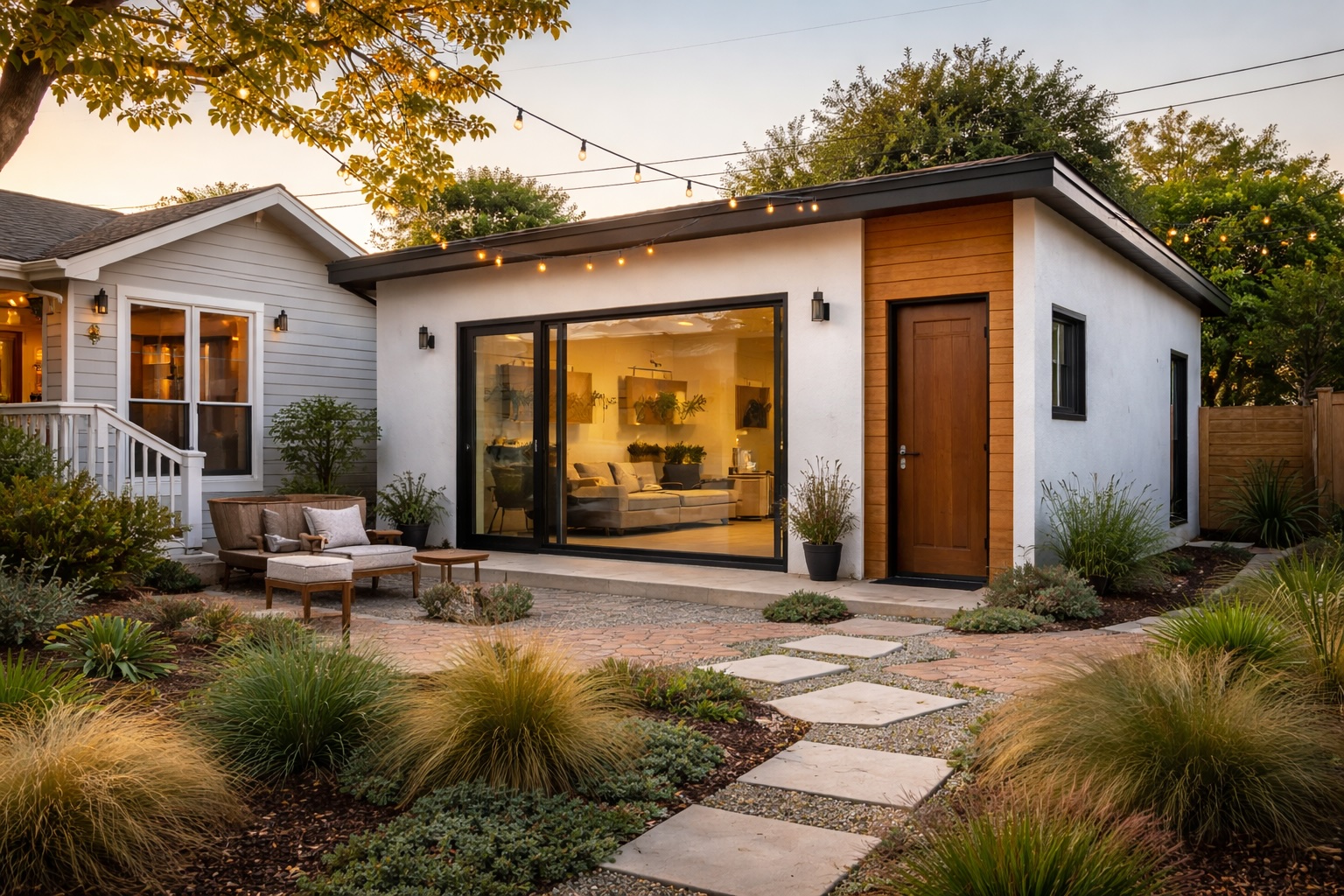
Quick Answer: Garage conversions to ADUs in Los Angeles cost $80,000-$150,000, while new detached ADUs run $150,000-$350,000. With new 2025 state laws eliminating many restrictions, you can add $2,500-$4,500 monthly rental income. Conversion takes 4-6 months from permits to occupancy.
Key Facts:
- Cost: $200-250 per square foot for conversions
- Timeline: 60 days permits + 3-4 months construction
- ROI: 3-4 year payback through rental income
- Size: 150-1,200 sq ft allowed by right
- Income: $2,500-$4,500/month depending on location
Converting your garage into an ADU or building a new accessory dwelling unit has become the smartest investment Los Angeles homeowners can make in 2025. With median rents hitting $3,200 monthly for one-bedrooms and new state laws eliminating previous barriers, that dusty garage storing holiday decorations could generate $40,000 annually in rental income.
The math is compelling: spend $120,000 converting your garage, rent it for $3,000 monthly, and you’ve paid off the investment in just over three years. After that, it’s pure profit. But the real opportunity goes beyond rental income – ADUs solve housing challenges for aging parents, provide space for adult children, or create the perfect home office with a separate entrance.

Get a Free Brochure
Get design ideas, information on materials, and more at your fingertips, and start planning your perfect project today. Transform your outdoor spaces with a luxury design & build company.
Get Your Free BrochureNew 2025 ADU Laws Change Everything
California’s latest ADU legislation, effective January 1, 2025, removes the obstacles that previously killed these projects. Understanding these changes is crucial for maximizing your property’s potential.
The biggest game-changer: owner-occupancy requirements are suspended through 2034. You no longer need to live on the property to build an ADU, opening opportunities for investment properties and vacation homes. This single change has doubled ADU applications in neighborhoods like Silver Lake and Mar Vista where investor-owned properties are common.
Parking requirements have been eliminated entirely if you’re within half a mile of public transit – which covers most of Los Angeles. Even outside transit areas, replacing required garage parking is no longer an issue. Cities can’t require replacement parking for garage conversions, period. This saves $15,000-$30,000 in construction costs and makes countless more properties viable for conversion.
Height restrictions have been relaxed significantly. ADUs can now reach 18 feet for attached units and 25 feet for detached ones on lots with multi-story main houses. Two-story ADUs above garages are explicitly allowed, maximizing space on typical 5,000-square-foot LA lots. In hillside areas like the Hollywood Hills, this creates opportunities for spectacular view units commanding premium rents.
The approval process is now ministerial, meaning cities must approve conforming plans within 60 days. No more discretionary review, no design committees, no neighbor input if you meet objective standards. Cities that drag their feet face state enforcement action. This certainty removes the risk of investing in plans only to face arbitrary denial.
Real Costs for Los Angeles ADU Projects
Let’s talk actual numbers based on current LA construction costs, not the lowball estimates floating around online. These figures include everything: design, permits, construction, and utilities.
Garage conversions run $80,000-$150,000 for typical 400-600 square foot spaces. The lower end gets you a basic studio with simple finishes. The higher end includes full kitchens, bathroom upgrades, and quality finishes that command higher rents. Structural modifications like raising the roof or adding windows significantly impact costs.
New detached ADUs cost $150,000-$350,000 depending on size and finish level. A basic 600-square-foot unit might hit the lower range, while a two-bedroom, 1,200-square-foot unit with high-end finishes reaches the upper end. Site conditions dramatically affect pricing – flat lots in the Valley cost less than hillside properties requiring retaining walls.
Junior ADUs (converting existing space within the house) offer the most affordable option at $30,000-$80,000. These 500-square-foot maximum units work well for existing bedrooms with exterior access. Adding a kitchenette and bathroom to a master suite creates perfect in-law quarters.
Hidden costs that surprise homeowners include utility connections ($5,000-$15,000 for separate meters), sewer lateral upgrades ($3,000-$8,000 for older homes), and electrical panel upgrades ($3,000-$5,000). Properties with existing structures need asbestos and lead testing, potentially adding remediation costs.
Site work varies wildly. Flat lots in Encino might need minimal grading, while a Laurel Canyon property could require $30,000 in retaining walls and drainage. Tree removal, especially protected species like oaks, involves permits and replacement requirements that add thousands.
ROI Analysis by LA Neighborhood
The rental income potential varies dramatically across Los Angeles, affecting your return on investment timeline. Here’s what different neighborhoods actually generate in monthly rent for well-designed ADUs:
Westside (Venice, Santa Monica, Mar Vista): $3,000-$4,500 for one-bedrooms. A $130,000 garage conversion pays for itself in three years. These coastal-adjacent areas command premium rents from tech workers and entertainment industry professionals. The challenge: stricter coastal commission oversight near the beach.
Central LA (Silver Lake, Los Feliz, Echo Park): $2,500-$3,500 monthly. Hip neighborhoods attract young professionals willing to pay for character and location. Converted garages with original details and modern amenities perform especially well. The artistic community values unique spaces over cookie-cutter apartments.
Valley (Sherman Oaks, Studio City, Woodland Hills): $2,200-$3,200 monthly. Family-friendly areas where ADUs often house extended family rather than generate rental income. When rented, proximity to studios and good schools drives demand. Larger lots mean more options for detached units.
South Bay (Manhattan Beach, Redondo Beach, Hermosa): $3,500-$5,000 monthly. Beach proximity justifies premium pricing. Many homeowners use ADUs as vacation rentals, though some cities restrict short-term rentals. Check local ordinances before planning an Airbnb strategy.
Beyond rental income, ADUs typically add 20-30% to property value. A $1.2 million home gaining $300,000 in value from a $150,000 ADU investment delivers instant equity. This appreciation happens immediately upon completion, not gradually like rental income ROI.
Design Strategies That Maximize Value
Smart design choices differentiate high-earning ADUs from average ones. In Los Angeles’s competitive rental market, thoughtful details command premium rents and attract quality tenants.
Separate entrances are non-negotiable for privacy and rental appeal. Side yard access works for most properties, but creative solutions like exterior staircases for above-garage units maximize land use. French doors or sliding glass walls create the indoor-outdoor flow LA renters expect, making small spaces feel larger.
Kitchen design makes or breaks rental potential. Full kitchens with standard appliances support higher rents than kitchenettes. Quartz countertops, tile backsplashes, and stainless steel appliances cost marginally more but signal quality. Open shelving instead of upper cabinets maintains airiness in compact spaces.
Bathroom finishes matter more than size. A well-designed 30-square-foot bathroom with quality tile, good lighting, and a glass shower door outperforms a larger space with builder-grade finishes. Wall-mounted vanities and toilets maximize floor space while looking modern.
Storage solutions prevent spaces from feeling cramped. Built-in closets, under-stair storage, and multi-functional furniture accommodate renters’ belongings. Murphy beds or sleeping lofts work in studios, though dedicated bedrooms command 20-30% higher rents.
Natural light transforms ADUs from dark converted garages into desirable living spaces. Skylights, clerestory windows, and glass doors brighten interiors without sacrificing privacy. LED lighting on dimmers provides ambiance and energy efficiency.
Permit and Timeline Reality
The permit process for Los Angeles ADUs has streamlined considerably, but realistic timelines prevent frustration and help plan for rental income.
Pre-submittal consultation takes 2-3 weeks. The LA Department of Building and Safety offers free meetings to review preliminary plans. This identifies potential issues before investing in complete drawings. Zoning clearances happen simultaneously, confirming your property’s ADU eligibility.
Plan development requires 3-6 weeks with an experienced designer. Architectural plans must show structural calculations, electrical layouts, plumbing schematics, and Title 24 energy compliance. DIY plans usually get rejected, wasting time and requiring professional help anyway.
Permit review now takes 60 days maximum for compliant applications. Building and Safety, Planning, and Fire Department review happens concurrently. Corrections are common – budget two rounds of plan check responses. Each correction round adds 2-3 weeks.
Construction runs 3-4 months for garage conversions, 4-6 months for new construction. This assumes no weather delays and available contractors. Foundation work and framing happen quickly; mechanical, electrical, and plumbing rough-in takes longer. Finishing work – drywall, flooring, fixtures – comprises the final third of the timeline.
Inspections occur at multiple stages: foundation, framing, rough electrical/plumbing/mechanical, insulation, drywall, and final. Failed inspections add days or weeks depending on correction complexity. Having an experienced contractor who knows local inspectors’ expectations prevents delays.
Garage Conversion Specifics
Transforming garages into living spaces involves unique challenges beyond new construction. Understanding these helps set realistic expectations and budgets.
Structural modifications often surprise homeowners. Garage slabs typically sit lower than house foundations, requiring raising or steps. Garage doors need proper headers when converted to walls with windows. Ceiling heights might be insufficient, necessitating roof modifications that add $15,000-$25,000.
Insulation and weatherproofing are critical for comfort. Garage walls and ceilings lack insulation, requiring complete thermal envelope creation. Moisture barriers prevent mold problems common in converted garages. Proper ventilation, often overlooked, prevents condensation issues that plague amateur conversions.
The garage door replacement deserves special attention. Simply filling the opening with stucco creates an obvious “converted garage” look that impacts property values. Better designs incorporate windows, doors, and architectural details matching the main house. Some homeowners retain decorative garage doors that open to patios, preserving curb appeal while gaining living space.
Heating and cooling system integration varies by existing home setup. Extending central HVAC costs more but provides better comfort. Mini-split systems offer independent climate control and energy efficiency. Either option beats space heaters and window units that scream “unpermitted conversion.”
Common Pitfalls and How to Avoid Them
Learning from others’ mistakes saves money and prevents project derailment. These issues appear repeatedly in failed or over-budget ADU projects across Los Angeles.
Underestimating total costs tops the list. Online calculators showing $50,000 garage conversions ignore LA reality. Between high labor costs, seismic requirements, and quality expectations for rentable units, budget at least $100,000 for legitimate garage conversions. Financing falling through mid-project creates nightmare scenarios.
Choosing the wrong contractor ruins projects. Unlicensed contractors offer tempting savings but can’t pull permits, leaving you with unpermitted units. Even licensed contractors need ADU experience – standard home remodelers often miss ADU-specific requirements. Check recent ADU projects, not just general references.
Ignoring utility capacity causes expensive surprises. Older homes’ 100-amp electrical panels can’t support ADU additions. Undersized sewer laterals require replacement. Gas meter capacity might need upgrading. These infrastructure improvements add $10,000-$20,000 if not identified early.
Designing without considering rental reality reduces income potential. That spiral staircase looks cool but alienates older renters. Tiny kitchens without dishwashers lose young professionals. Insufficient parking frustrates tenants even if not legally required. Design for your target renter, not abstract aesthetics.
Making the Decision
Building an ADU in 2025 makes sense if you plan to stay in your home five-plus years, need rental income or family housing, and can handle the construction financing. The combination of new laws, housing demand, and rental rates creates an unprecedented opportunity window.
February starts the perfect timeline for summer completion. LA designers and contractors have availability before the spring rush. Permit offices operate efficiently before peak season. Construction happens during dry weather, avoiding winter rain delays.
The opportunity won’t last forever. As more ADUs enter the rental market, premium rents will moderate. Construction costs continue rising 5-10% annually. Future legislation might restore restrictions as neighborhood opposition organizes. Acting now captures maximum advantage.
Ready to transform your garage or build an ADU? MG Construction & Decks specializes in ADU development throughout Los Angeles, from initial feasibility studies through final inspection. We handle garage conversions, new construction, and junior ADUs with expertise in challenging hillside lots and historic neighborhoods. Contact us for a realistic assessment of your property’s ADU potential and accurate cost estimates based on current market conditions.